
Leave-One-Out (LOO) predictive checks. See the Plot Descriptions section, below, and Gabry et al. (2019) for details.
Usage
ppc_loo_pit_overlay(
  y,
  yrep,
  lw = NULL,
  ...,
  psis_object = NULL,
  pit = NULL,
  samples = 100,
  size = 0.25,
  alpha = 0.7,
  boundary_correction = TRUE,
  grid_len = 512,
  bw = NULL,
  trim = FALSE,
  adjust = NULL,
  kernel = NULL,
  n_dens = NULL
)

ppc_loo_pit_data(
  y,
  yrep,
  lw = NULL,
  ...,
  psis_object = NULL,
  pit = NULL,
  samples = 100,
  bw = "nrd0",
  boundary_correction = TRUE,
  grid_len = 512
)

ppc_loo_pit_qq(
  y,
  yrep,
  lw = NULL,
  ...,
  psis_object = NULL,
  pit = NULL,
  compare = c("uniform", "normal"),
  size = 2,
  alpha = 1
)

ppc_loo_pit_ecdf(
  y,
  yrep,
  lw = NULL,
  ...,
  psis_object = NULL,
  pit = NULL,
  K = NULL,
  prob = 0.99,
  plot_diff = FALSE,
  interpolate_adj = NULL,
  method = NULL,
  test = NULL,
  gamma = NULL,
  linewidth = NULL,
  color = NULL,
  help_text = NULL,
  pareto_pit = NULL,
  help_text_shrinkage = NULL
)

ppc_loo_pit(
  y,
  yrep,
  lw,
  pit = NULL,
  compare = c("uniform", "normal"),
  ...,
  size = 2,
  alpha = 1
)

ppc_loo_intervals(
  y,
  yrep,
  psis_object,
  ...,
  subset = NULL,
  intervals = NULL,
  prob = 0.5,
  prob_outer = 0.9,
  alpha = 0.33,
  size = 1,
  fatten = 2.5,
  linewidth = 1,
  order = c("index", "median")
)

ppc_loo_ribbon(
  y,
  yrep,
  psis_object,
  ...,
  subset = NULL,
  intervals = NULL,
  prob = 0.5,
  prob_outer = 0.9,
  alpha = 0.33,
  size = 0.25
)
Arguments
- y
A vector of observations. See Details.
- yrep
An
SbyNmatrix of draws from the posterior (or prior) predictive distribution, or aposterior::drawsobject. The number of rows,S, is the size of the posterior (or prior) sample used to generateyrep. The number of columns,Nis the number of predicted observations (length(y)). The columns ofyrepshould be in the same order as the data points inyfor the plots to make sense. See the Details and Plot Descriptions sections for additional advice specific to particular plots.- lw
A matrix of (smoothed) log weights with the same dimensions as
yrep. Seeloo::psis()and the associatedweights()method as well as the Examples section, below. Iflwis not specified thenpsis_objectcan be provided and log weights will be extracted.- ...
Currently unused.
- psis_object
If using loo version
2.0.0or greater, an object returned by thepsis()function (or by theloo()function with argumentsave_psisset toTRUE).- pit
For
ppc_loo_pit_overlay(),ppc_loo_pit_qq(), andppc_loo_pit_ecdf(), an optional vector of precomputed LOO-PIT values (lengthlength(y), values in[0, 1]). If supplied,y,yrep, andlw/psis_objectare ignored. IfNULL(default), LOO-PIT values are computed internally.- samples
For
ppc_loo_pit_overlay(), the number of data sets (each the same size asy) to simulate from the standard uniform distribution. The default is 100. The density estimate of each dataset is plotted as a thin line in the plot, with the density estimate of the LOO PITs overlaid as a thicker dark line.- alpha, size, fatten, linewidth
Arguments passed to code geoms to control plot aesthetics. For
ppc_loo_pit_qq()andppc_loo_pit_overlay(),sizeandalphaare passed toggplot2::geom_point()andggplot2::geom_density(), respectively. Forppc_loo_intervals(),sizelinewidthandfattenare passed toggplot2::geom_pointrange(). Forppc_loo_ribbon(),alphaandsizeare passed toggplot2::geom_ribbon(). Forppc_loo_pit_ecdf(), linewidth for the ECDF plot. Whenmethod = "correlated", defaults to 0.3. Whenmethod = "independent", ifNULLno linewidth is specified for the ECDF line.- boundary_correction
For
ppc_loo_pit_overlay(), when set toTRUE(the default) the function will compute boundary corrected density values via convolution and a Gaussian filter, also known as the reflection method (Boneva et al., 1971). As a result, parameters controlling the standard kernel density estimation such asadjust,kernelandn_densare ignored. NOTE: The current implementation only works well for continuous observations.- grid_len
For
ppc_loo_pit_overlay(), whenboundary_correctionis set toTRUEthis parameter specifies the number of points used to generate the estimations. This is set to 512 by default.- bw, adjust, kernel, n_dens
Optional arguments passed to
stats::density()to override the defaults.- trim
Passed to
ggplot2::stat_density().- compare
For
ppc_loo_pit_qq(), a string that can be either"uniform"or"normal". If"uniform"(the default) the Q-Q plot compares computed PIT values to the standard uniform distribution. Ifcompare="normal", the Q-Q plot compares standard normal quantiles calculated from the PIT values to the theoretical standard normal quantiles.- K
An optional integer defining the number of equally spaced evaluation points for the PIT-ECDF. Reducing K when using
interpolate_adj = FALSEmakes computing the confidence bands faster. Forppc_loo_pit_ecdf(), whenmethod = 'independent'. Ifpitis supplied, defaults tolength(pit), otherwiseyrepdetermines the maximum accuracy of the estimated PIT values andKis set tomin(nrow(yrep) + 1, 1000).- prob, prob_outer
Values between
0and1indicating the desired probability mass to include in the inner and outer intervals. The defaults areprob=0.5andprob_outer=0.9forppc_loo_intervals()andprob = 0.99forppc_loo_pit_ecdf().- plot_diff
A boolean defining whether to plot the difference between the observed PIT-ECDF and the theoretical expectation for uniform PIT values rather than plotting the regular ECDF. For
ppc_loo_pit_ecdf(), whenmethod = 'independent'. The default isFALSE, but for large samples we recommend settingplot_diff = TRUEto better use the plot area.- interpolate_adj
A boolean defining if the simultaneous confidence bands should be interpolated based on precomputed values rather than computed exactly. Computing the bands may be computationally intensive and the approximation gives a fast method for assessing the ECDF trajectory. For
ppc_loo_pit_ecdf()whenmethod = 'independent'. The default is to use interpolation ifKis greater than 200.- method
The method used to calculate the uniformity test:
"independent": assumes independent PIT values (Säilynoja et al., 2022)."correlated": accounts for correlated PIT values (Tesso & Vehtari, 2026).
- test
When
method = "correlated", which dependence-aware test to use:"POT","PRIT", or"PIET". Defaults to"POT".- gamma
When
method = "correlated", tolerance threshold controlling how strongly suspicious points are flagged. Larger values (gamma > 0) emphasize points with larger deviations. IfNULL, defaults to0and thus all suspicious points are flagged.- color
When
method = "correlated", a named character vector of plot colors with elementsecdfandhighlight.ecdfis used for the main ECDF line;highlightfor suspicious regions flagged by the uniformity test. Defaults toc(ecdf = "grey60", highlight = "red"). Values must be valid ggplot2 colors (e.g. R color names or hex codes). Ignored whenmethod = "independent".- help_text
When
method = "correlated", a boolean defining whether to add information about p-value to the plot. Defaults toTRUE.- pareto_pit
A boolean defining whether to compute PIT values using Pareto-PIT method. Defaults to
TRUEiftestis either"POT"or"PIET"and nopitvalues are provided otherwiseFALSE. This argument should normally not be modified by the user, except for development purposes. Ifpitis non-NULL,pareto_pitcannot be simultaneouslyTRUE.- help_text_shrinkage
When
method = "correlated", a numeric value between 0 and 1 defining the factor by which the help-text (p-value information) is scaled. The default is0.8.- subset
For
ppc_loo_intervals()andppc_loo_ribbon(), an optional integer vector indicating which observations iny(andyrep) to include. Dropping observations fromyandyrepmanually before passing them to the plotting function will not work because the dimensions will not match up with the dimensions ofpsis_object, but if all ofyandyrepare passed along withsubsetthen bayesplot can do the subsetting internally fory,yrepandpsis_object. See the Examples section for a demonstration.- intervals
For
ppc_loo_intervals()andppc_loo_ribbon(), optionally a matrix of pre-computed LOO predictive intervals that can be specified instead ofyrep(ignored ifintervalsis specified). If not specified the intervals are computed internally before plotting. If specified,intervalsmust be a matrix with number of rows equal to the number of data points and five columns in the following order: lower outer interval, lower inner interval, median (50%), upper inner interval and upper outer interval (column names are ignored).- order
For
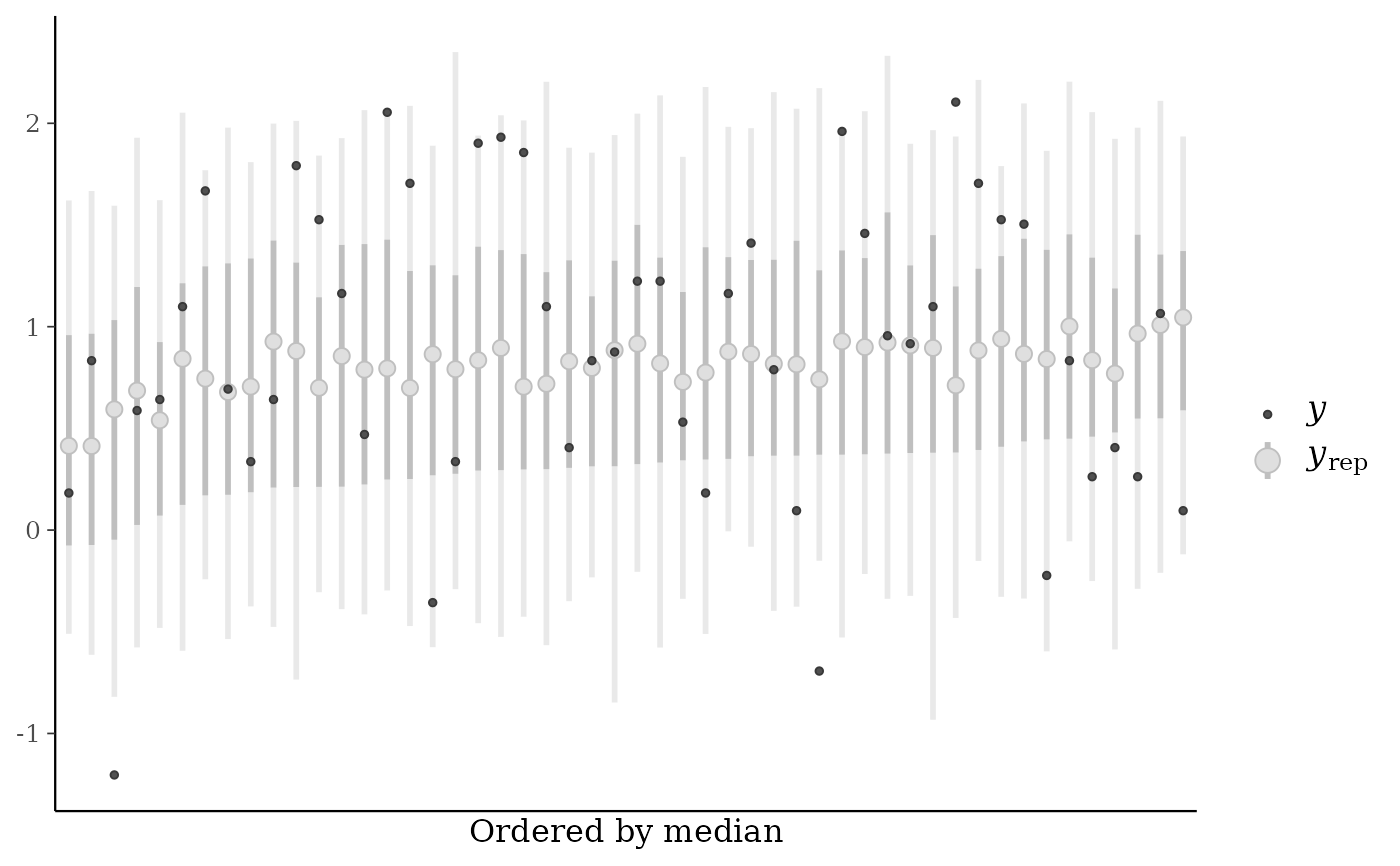
ppc_loo_intervals(), a string indicating how to arrange the plotted intervals. The default ("index") is to plot them in the order of the observations. The alternative ("median") arranges them by median value from smallest (left) to largest (right).
Value
The plotting functions return a ggplot object that can be further
customized using the ggplot2 package. The functions with suffix
_data() return the data that would have been drawn by the plotting
function.
Plot Descriptions
ppc_loo_pit_data()This function prepares LOO-PIT data for plotting with ggplot2. It is the data-preparation back end for the LOO-PIT plotting functions (
ppc_loo_pit_overlay(),ppc_loo_pit_qq(), andppc_loo_pit_ecdf()), and users can call it directly to create custom LOO-PIT plots using ggplot2. The function computes the leave-one-out probability integral transform (LOO-PIT) values and returns a data frame that can be used to build ggplot objects. This is useful when you want to create custom visualizations of LOO-PIT values beyond what the built-in plotting functions provide.ppc_loo_pit_overlay(),ppc_loo_pit_qq(),ppc_loo_pit_ecdf()The calibration of marginal predictions can be assessed using probability integral transformation (PIT) checks. LOO improves the check by avoiding the double use of data. See the section on marginal predictive checks in Gelman et al. (2013, p. 152–153) and section 5 of Gabry et al. (2019) for an example of using bayesplot for these checks.
The LOO PIT values are asymptotically uniform (for continuous data) if the model is calibrated. The
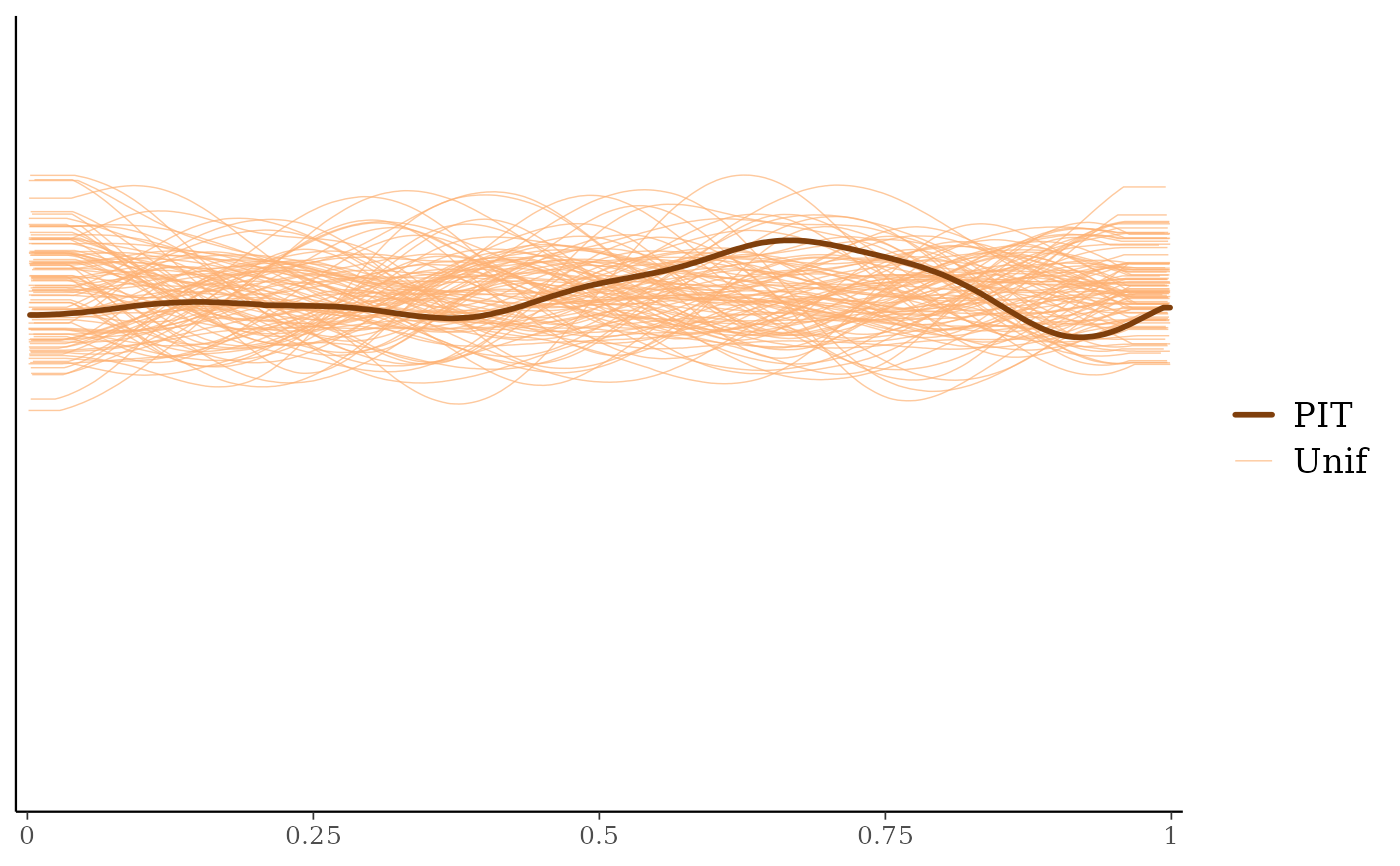
ppc_loo_pit_overlay()function creates a plot comparing the density of the LOO PITs (thick line) to the density estimates of many simulated data sets from the standard uniform distribution (thin lines). See Gabry et al. (2019) for an example of interpreting the shape of the miscalibration that can be observed in these plots.The
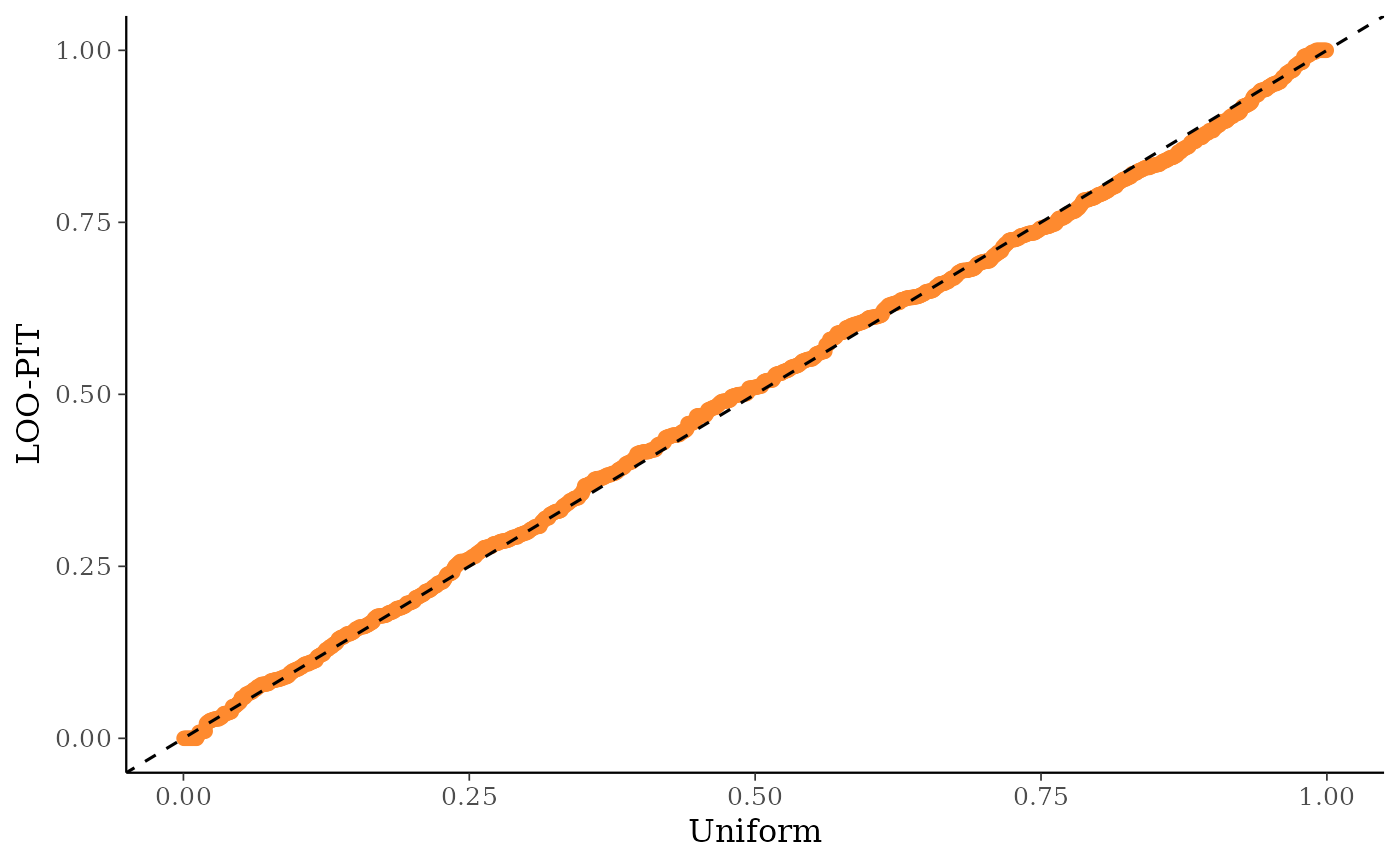
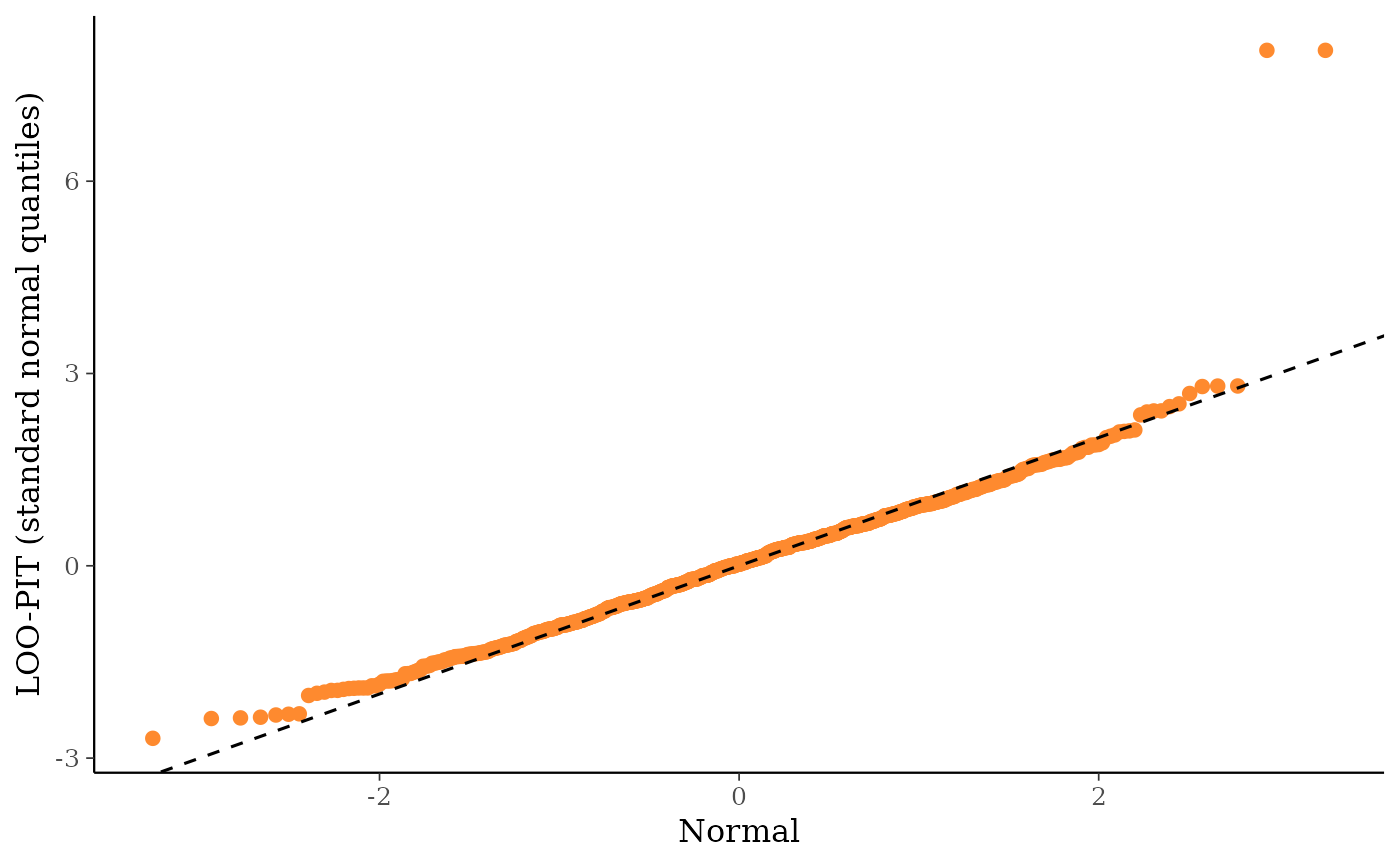
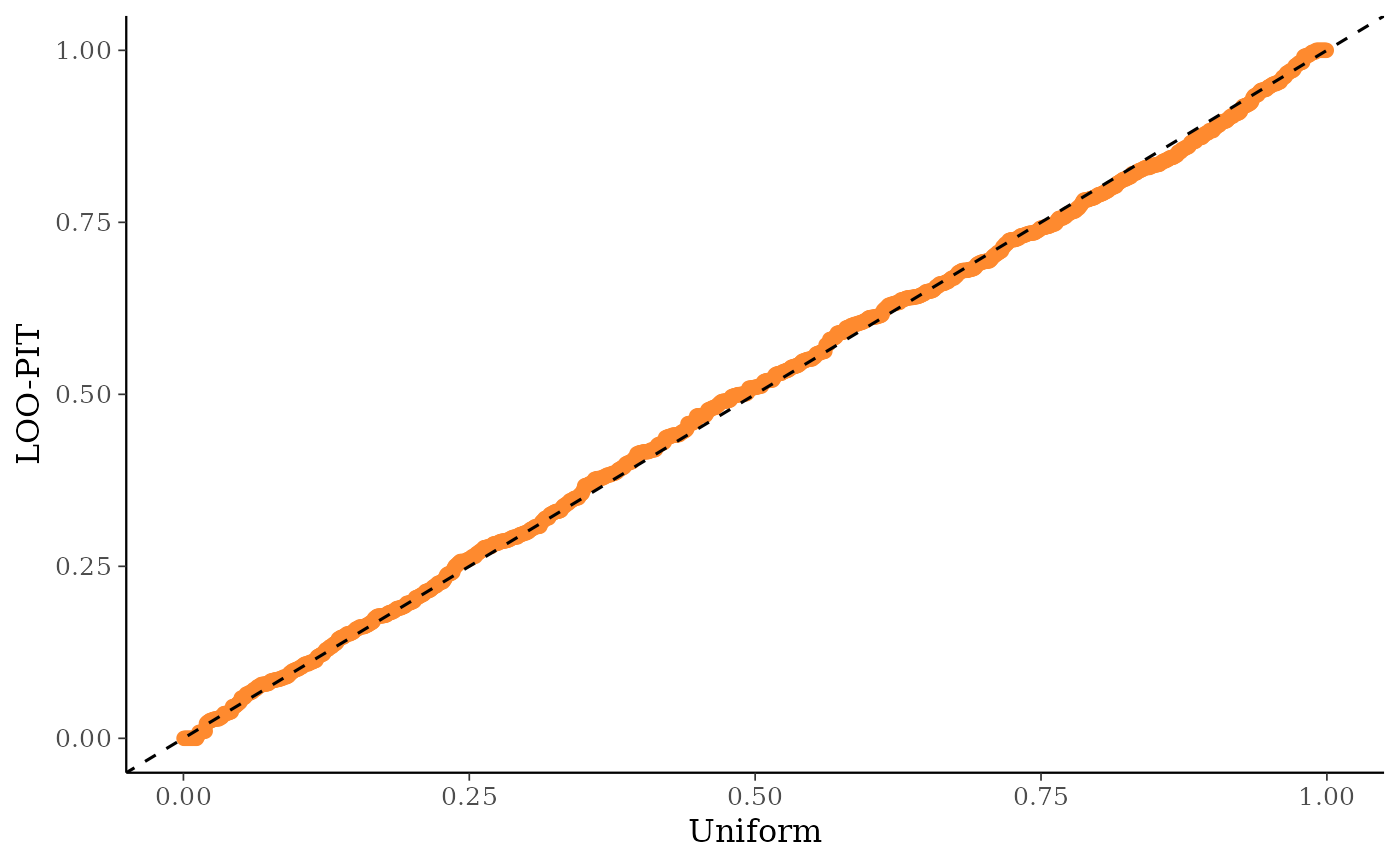
ppc_loo_pit_qq()function provides an alternative visualization of the miscalibration with a quantile-quantile (Q-Q) plot comparing the LOO PITs to the standard uniform distribution. Comparing to the uniform is not good for extreme probabilities close to 0 and 1, so it can sometimes be useful to set thecompareargument to"normal", which will produce a Q-Q plot comparing standard normal quantiles calculated from the PIT values to the theoretical standard normal quantiles. This can help see the (mis)calibration better for the extreme values. However, in most cases we have found that the overlaid density plot (ppc_loo_pit_overlay()) function will provide a clearer picture of calibration problems than the Q-Q plot.The
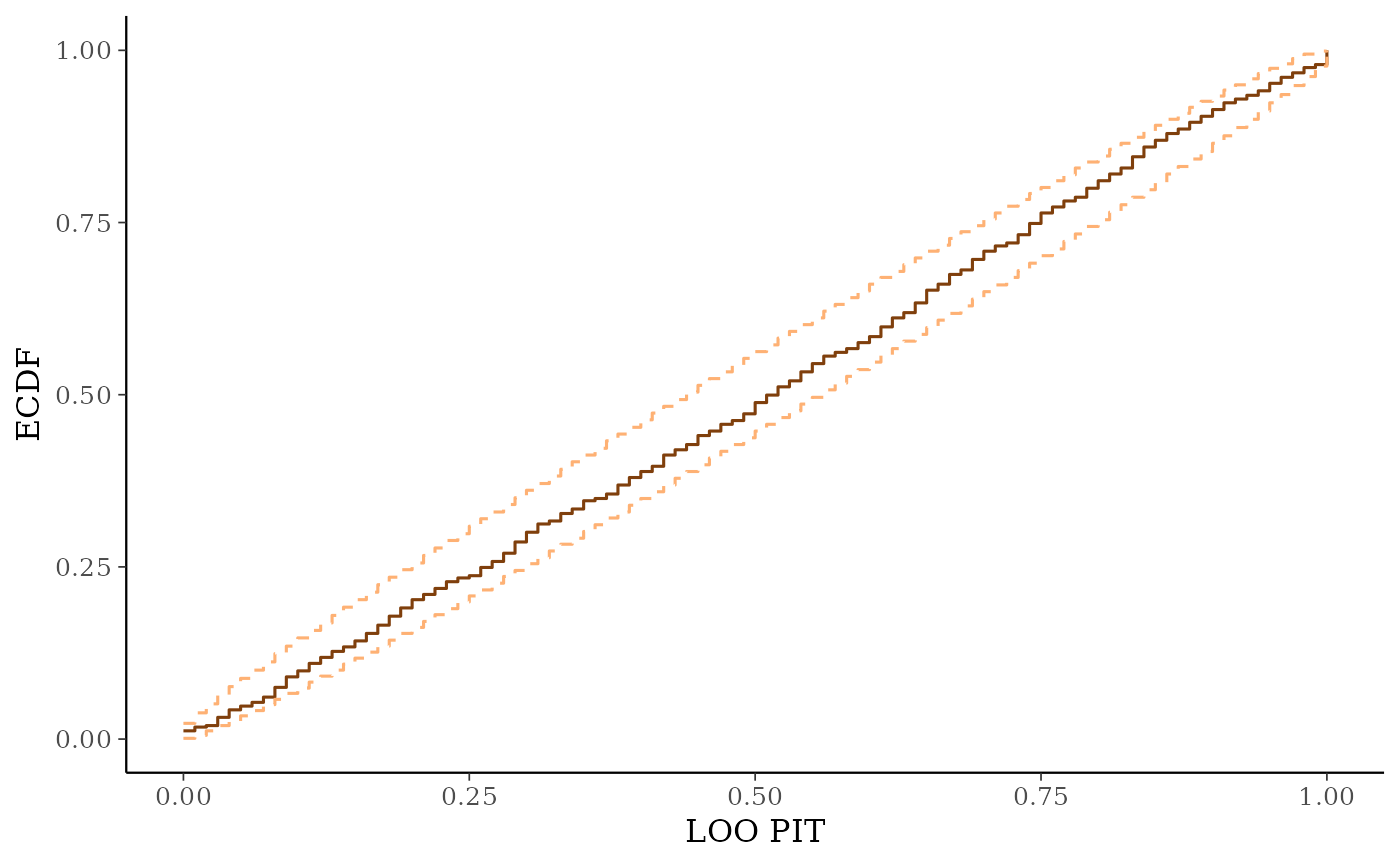
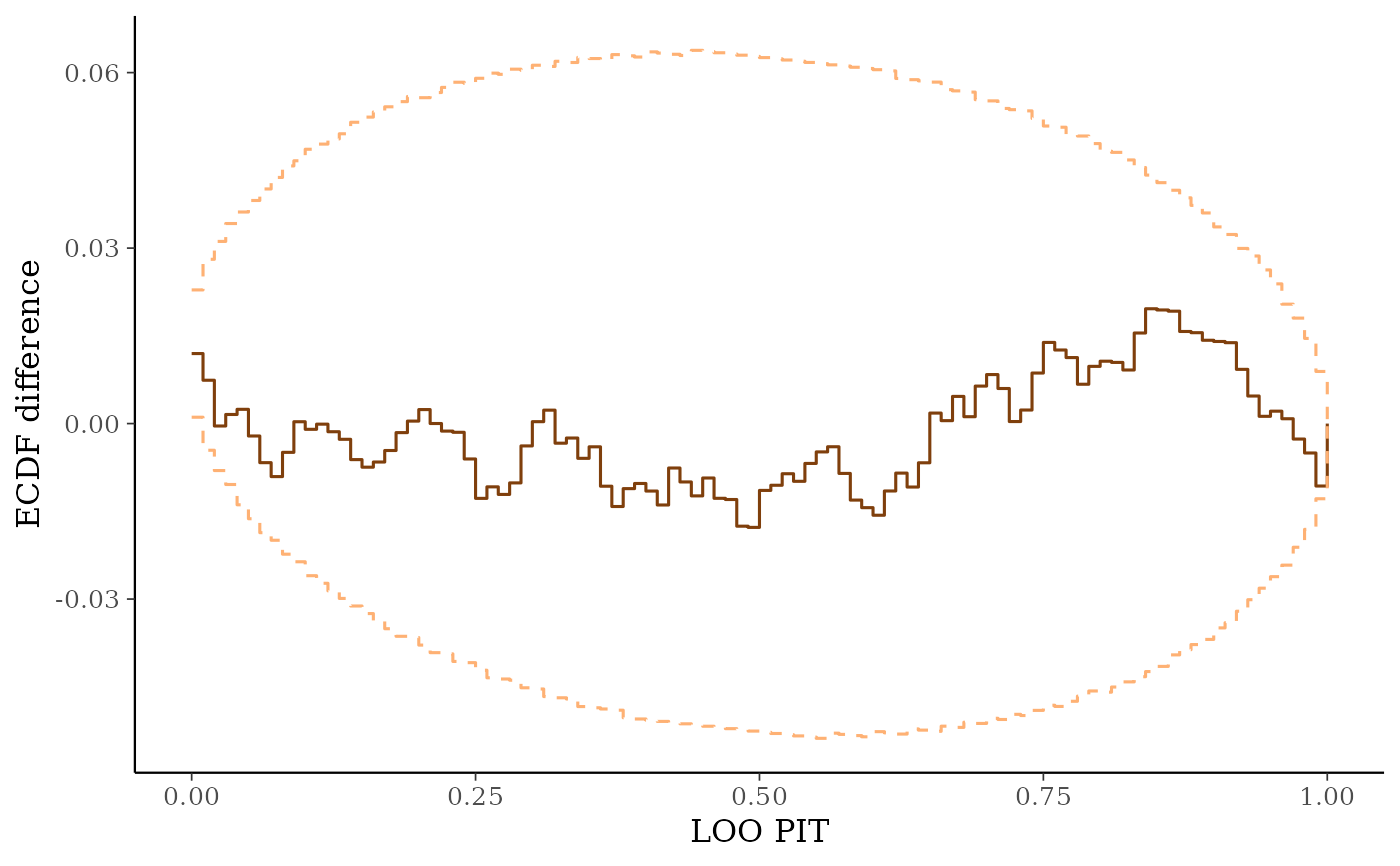
ppc_loo_pit_ecdf()function visualizes the empirical cumulative distribution function (ECDF) of the LOO PIT values. Withmethod = "independent", the plot overlays100 * prob% simultaneous confidence intervals for a standard uniform sample. Withmethod = "correlated", the plot uses a dependence-aware uniformity assessment and can highlight suspicious regions. Settingplot_diff = TRUEdisplays the ECDF minus the theoretical expectation, which can improve visual assessment of calibration. Note that the default "independent" method is superseded by the "correlated" method (Tesso & Vehtari, 2026) which accounts for dependent LOO-PIT values.ppc_loo_intervals(),ppc_loo_ribbon()Similar to
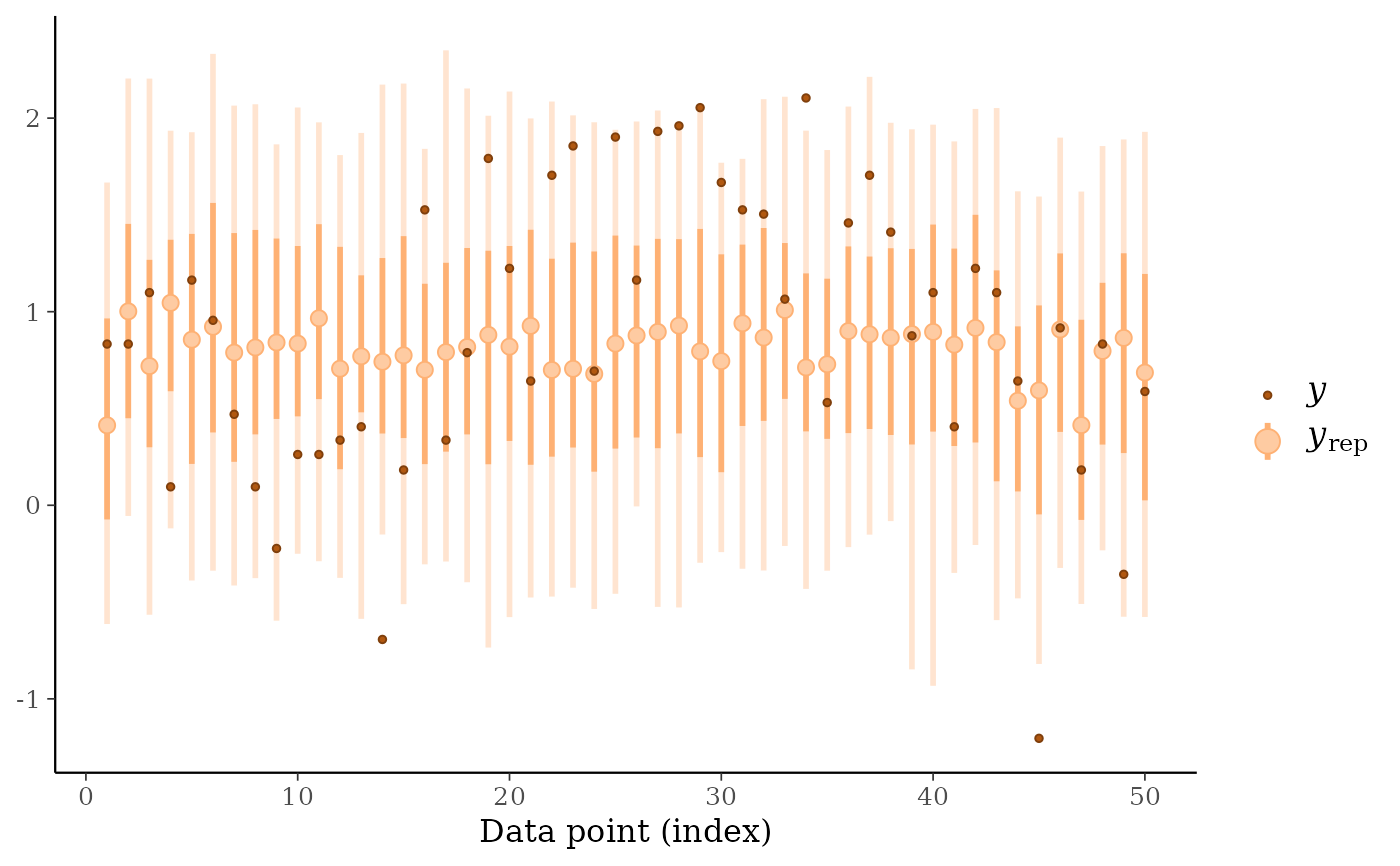
ppc_intervals()andppc_ribbon()but the intervals are for the LOO predictive distribution.
References
Gelman, A., Carlin, J. B., Stern, H. S., Dunson, D. B., Vehtari, A., and Rubin, D. B. (2013). Bayesian Data Analysis. Chapman & Hall/CRC Press, London, third edition. (p. 152–153)
Gabry, J. , Simpson, D. , Vehtari, A. , Betancourt, M. and Gelman, A. (2019), Visualization in Bayesian workflow. J. R. Stat. Soc. A, 182: 389-402. doi:10.1111/rssa.12378. (journal version, arXiv preprint, code on GitHub)
Vehtari, A., Gelman, A., and Gabry, J. (2017). Practical Bayesian model evaluation using leave-one-out cross-validation and WAIC. Statistics and Computing. 27(5), 1413–1432. doi:10.1007/s11222-016-9696-4. arXiv preprint: https://arxiv.org/abs/1507.04544
Boneva, L. I., Kendall, D., & Stefanov, I. (1971). Spline transformations: Three new diagnostic aids for the statistical data-analyst. J. R. Stat. Soc. B (Methodological), 33(1), 1-71. https://www.jstor.org/stable/2986005.
Tesso, H., & Vehtari, A. (2026). LOO-PIT predictive model checking. arXiv preprint https://arxiv.org/abs/2603.02928.
Examples
# \dontrun{
library(rstanarm)
library(loo)
#> This is loo version 2.10.1
#> - Online documentation and vignettes at mc-stan.org/loo
#> - As of v2.0.0 loo defaults to 1 core but we recommend using as many as possible. Use the 'cores' argument or set options(mc.cores = NUM_CORES) for an entire session.
#>
#> Attaching package: ‘loo’
#> The following object is masked from ‘package:rstan’:
#>
#> loo
head(radon)
#> floor county log_radon log_uranium
#> 1 1 AITKIN 0.83290912 -0.6890476
#> 2 0 AITKIN 0.83290912 -0.6890476
#> 3 0 AITKIN 1.09861229 -0.6890476
#> 4 0 AITKIN 0.09531018 -0.6890476
#> 5 0 ANOKA 1.16315081 -0.8473129
#> 6 0 ANOKA 0.95551145 -0.8473129
fit <- stan_lmer(
log_radon ~ floor + log_uranium + floor:log_uranium
+ (1 + floor | county),
data = radon,
iter = 100,
chains = 2,
cores = 2
)
#> Warning: The largest R-hat is 1.15, indicating chains have not mixed.
#> Running the chains for more iterations may help. See
#> https://mc-stan.org/misc/warnings.html#r-hat
#> Warning: Bulk Effective Samples Size (ESS) is too low, indicating posterior means and medians may be unreliable.
#> Running the chains for more iterations may help. See
#> https://mc-stan.org/misc/warnings.html#bulk-ess
#> Warning: Tail Effective Samples Size (ESS) is too low, indicating posterior variances and tail quantiles may be unreliable.
#> Running the chains for more iterations may help. See
#> https://mc-stan.org/misc/warnings.html#tail-ess
y <- radon$log_radon
yrep <- posterior_predict(fit)
loo1 <- loo(fit, save_psis = TRUE, cores = 4)
#> Warning: Found 10 observation(s) with a pareto_k > 0.7. We recommend calling 'loo' again with argument 'k_threshold = 0.7' in order to calculate the ELPD without the assumption that these observations are negligible. This will refit the model 10 times to compute the ELPDs for the problematic observations directly.
psis1 <- loo1$psis_object
lw <- weights(psis1) # normalized log weights
# marginal predictive check using LOO probability integral transform
color_scheme_set("orange")
ppc_loo_pit_overlay(y, yrep, lw = lw)
#> Some PIT values larger than 1! Largest: 1
#> Rounding PIT > 1 to 1. Gradient evaluation took 0.000415 seconds
#> Chain 2: 1000 transitions using 10 leapfrog steps per transition would take 4.15 seconds.
#> Chain 2: Adjust your expectations accordingly!
#> Chain 2:
#> Chain 2:
#> Chain 2: WARNING: There aren't enough warmup iterations to fit the
#> Chain 2: three stages of adaptation as currently configured.
#> Chain 2: Reducing each adaptation stage to 15%/75%/10% of
#> Chain 2: the given number of warmup iterations:
#> Chain 2: init_buffer = 7
#> Chain 2: adapt_window = 38
#> Chain 2: term_buffer = 5
#> Chain 2:
#> Chain 2: Iteration: 1 / 100 [ 1%] (Warmup)
#> Chain 2: Iteration: 10 / 100 [ 10%] (Warmup)
#> Chain 1: Iteration: 10 / 100 [ 10%] (Warmup)
#> Chain 2: Iteration: 20 / 100 [ 20%] (Warmup)
#> Chain 1: Iteration: 20 / 100 [ 20%] (Warmup)
#> Chain 2: Iteration: 30 / 100 [ 30%] (Warmup)
#> Chain 1: Iteration: 30 / 100 [ 30%] (Warmup)
#> Chain 2: Iteration: 40 / 100 [ 40%] (Warmup)
#> Chain 1: Iteration: 40 / 100 [ 40%] (Warmup)
#> Chain 2: Iteration: 50 / 100 [ 50%] (Warmup)
#> Chain 2: Iteration: 51 / 100 [ 51%] (Sampling)
#> Chain 1: Iteration: 50 / 100 [ 50%] (Warmup)
#> Chain 1: Iteration: 51 / 100 [ 51%] (Sampling)
#> Chain 2: Iteration: 60 / 100 [ 60%] (Sampling)
#> Chain 1: Iteration: 60 / 100 [ 60%] (Sampling)
#> Chain 2: Iteration: 70 / 100 [ 70%] (Sampling)
#> Chain 1: Iteration: 70 / 100 [ 70%] (Sampling)
#> Chain 2: Iteration: 80 / 100 [ 80%] (Sampling)
#> Chain 1: Iteration: 80 / 100 [ 80%] (Sampling)
#> Chain 2: Iteration: 90 / 100 [ 90%] (Sampling)
#> Chain 1: Iteration: 90 / 100 [ 90%] (Sampling)
#> Chain 2: Iteration: 100 / 100 [100%] (Sampling)
#> Chain 2:
#> Chain 2: Elapsed Time: 2.245 seconds (Warm-up)
#> Chain 2: 2.041 seconds (Sampling)
#> Chain 2: 4.286 seconds (Total)
#> Chain 2:
#> Chain 1: Iteration: 100 / 100 [100%] (Sampling)
#> Chain 1:
#> Chain 1: Elapsed Time: 2.319 seconds (Warm-up)
#> Chain 1: 2.038 seconds (Sampling)
#> Chain 1: 4.357 seconds (Total)
#> Chain 1:
#> Warning:
#> NOTE: The kernel density estimate assumes continuous observations and is not optimal for discrete observations.
 ppc_loo_pit_qq(y, yrep, lw = lw)
#> Warning:
ppc_loo_pit_qq(y, yrep, lw = lw)
#> Warning:
 ppc_loo_pit_qq(y, yrep, lw = lw, compare = "normal")
#> Warning:
#> Warning: Removed 13 rows containing non-finite outside the scale range (`stat_qq()`).
ppc_loo_pit_qq(y, yrep, lw = lw, compare = "normal")
#> Warning:
#> Warning: Removed 13 rows containing non-finite outside the scale range (`stat_qq()`).
 # predictive calibration check using LOO probability integral transform
ppc_loo_pit_ecdf(y, yrep, lw)
#> ℹ In the next major release, the default `method` will change to 'correlated'.
#> • To silence this message, explicitly set `method = 'independent'` or
#> `method = 'correlated'`.
#> Warning:
# predictive calibration check using LOO probability integral transform
ppc_loo_pit_ecdf(y, yrep, lw)
#> ℹ In the next major release, the default `method` will change to 'correlated'.
#> • To silence this message, explicitly set `method = 'independent'` or
#> `method = 'correlated'`.
#> Warning:
 # With `plot_diff = TRUE` it is easier to assess the calibration.
ppc_loo_pit_ecdf(y, yrep, lw, plot_diff = TRUE)
#> ℹ In the next major release, the default `method` will change to 'correlated'.
#> • To silence this message, explicitly set `method = 'independent'` or
#> `method = 'correlated'`.
#> Warning:
# With `plot_diff = TRUE` it is easier to assess the calibration.
ppc_loo_pit_ecdf(y, yrep, lw, plot_diff = TRUE)
#> ℹ In the next major release, the default `method` will change to 'correlated'.
#> • To silence this message, explicitly set `method = 'independent'` or
#> `method = 'correlated'`.
#> Warning:
 # can use the psis object instead of lw
ppc_loo_pit_qq(y, yrep, psis_object = psis1)
#> Warning:
# can use the psis object instead of lw
ppc_loo_pit_qq(y, yrep, psis_object = psis1)
#> Warning:
 # loo predictive intervals vs observations
keep_obs <- 1:50
ppc_loo_intervals(y, yrep, psis_object = psis1, subset = keep_obs)
# loo predictive intervals vs observations
keep_obs <- 1:50
ppc_loo_intervals(y, yrep, psis_object = psis1, subset = keep_obs)
 color_scheme_set("gray")
ppc_loo_intervals(y, yrep,
psis_object = psis1, subset = keep_obs,
order = "median"
)
color_scheme_set("gray")
ppc_loo_intervals(y, yrep,
psis_object = psis1, subset = keep_obs,
order = "median"
)
 # }
# }