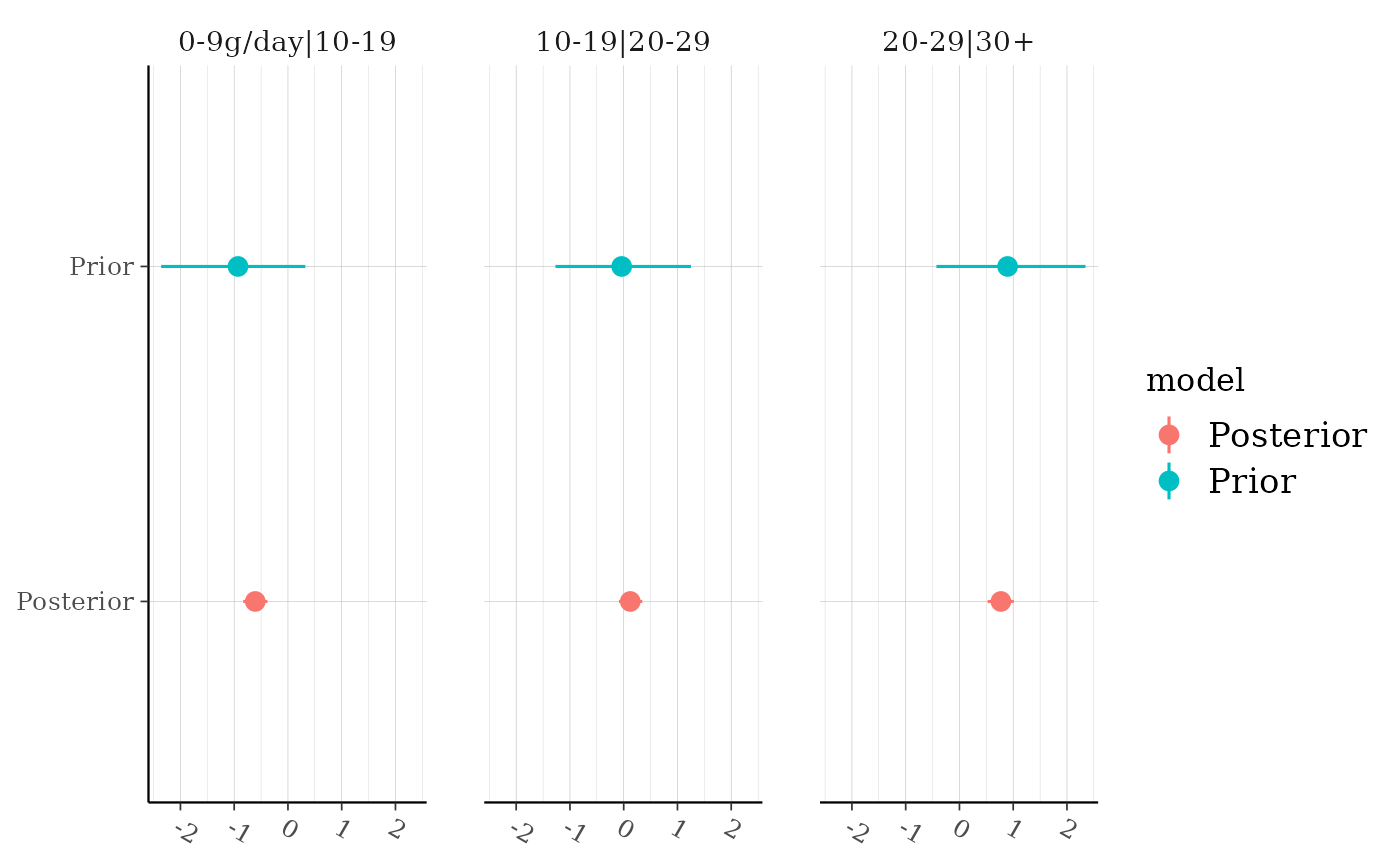
Plot medians and central intervals comparing parameter draws from the prior
and posterior distributions. If the plotted priors look different than the
priors you think you specified it is likely either because of internal
rescaling or the use of the QR argument (see the documentation for the
prior_summary method for details on
these special cases).
Arguments
- object
A fitted model object returned by one of the rstanarm modeling functions. See
stanreg-objects.- ...
The S3 generic uses
...to pass arguments to any defined methods. For the method for stanreg objects,...is for arguments (other thancolor) passed togeom_pointrangein the ggplot2 package to control the appearance of the plotted intervals.- pars
An optional character vector specifying a subset of parameters to display. Parameters can be specified by name or several shortcuts can be used. Using
pars="beta"will restrict the displayed parameters to only the regression coefficients (without the intercept)."alpha"can also be used as a shortcut for"(Intercept)". If the model has varying intercepts and/or slopes they can be selected usingpars = "varying".In addition, for
stanmvregobjects there are some additional shortcuts available. Usingpars = "long"will display the parameter estimates for the longitudinal submodels only (excluding group-specific pparameters, but including auxiliary parameters). Usingpars = "event"will display the parameter estimates for the event submodel only, including any association parameters. Usingpars = "assoc"will display only the association parameters. Usingpars = "fixef"will display all fixed effects, but not the random effects or the auxiliary parameters.parsandregex_parsare set toNULLthen all fixed effect regression coefficients are selected, as well as any auxiliary parameters and the log posterior.If
parsisNULLall parameters are selected for astanregobject, while for astanmvregobject all fixed effect regression coefficients are selected as well as any auxiliary parameters and the log posterior. See Examples.- regex_pars
An optional character vector of regular expressions to use for parameter selection.
regex_parscan be used in place ofparsor in addition topars. Currently, all functions that accept aregex_parsargument ignore it for models fit using optimization.- prob
A number \(p \in (0,1)\) indicating the desired posterior probability mass to include in the (central posterior) interval estimates displayed in the plot. The default is \(0.9\).
- color_by
How should the estimates be colored? Use
"parameter"to color by parameter name,"vs"to color the prior one color and the posterior another, and"none"to use no color. Except whencolor_by="none", a variable is mapped to the coloraesthetic and it is therefore also possible to change the default colors by adding one of the various discrete color scales available inggplot2(scale_color_manual,scale_colour_brewer, etc.). See Examples.- group_by_parameter
Should estimates be grouped together by parameter (
TRUE) or by posterior and prior (FALSE, the default)?- facet_args
A named list of arguments passed to
facet_wrap(other than thefacetsargument), e.g.,nroworncolto change the layout,scalesto allow axis scales to vary across facets, etc. See Examples.
References
Gabry, J. , Simpson, D. , Vehtari, A. , Betancourt, M. and Gelman, A. (2019), Visualization in Bayesian workflow. J. R. Stat. Soc. A, 182: 389-402. doi:10.1111/rssa.12378, arXiv preprint, code on GitHub)
Examples
if (.Platform$OS.type != "windows" || .Platform$r_arch != "i386") {
# \dontrun{
if (!exists("example_model")) example(example_model)
# display non-varying (i.e. not group-level) coefficients
posterior_vs_prior(example_model, pars = "beta")

# show group-level (varying) parameters and group by parameter
posterior_vs_prior(example_model, pars = "varying",
                   group_by_parameter = TRUE, color_by = "vs")

# group by parameter and allow axis scales to vary across facets
posterior_vs_prior(example_model, regex_pars = "period",
                   group_by_parameter = TRUE, color_by = "none",
                   facet_args = list(scales = "free"))

# assign to object and customize with functions from ggplot2
(gg <- posterior_vs_prior(example_model, pars = c("beta", "varying"), prob = 0.8))

gg +
 ggplot2::geom_hline(yintercept = 0, size = 0.3, linetype = 3) +
 ggplot2::coord_flip() +
 ggplot2::ggtitle("Comparing the prior and posterior")

# compare very wide and very narrow priors using roaches example
# (see help(roaches, "rstanarm") for info on the dataset)
roaches$roach100 <- roaches$roach1 / 100
wide_prior <- normal(0, 10)
narrow_prior <- normal(0, 0.1)
fit_pois_wide_prior <- stan_glm(y ~ treatment + roach100 + senior,
                                offset = log(exposure2),
                                family = "poisson", data = roaches,
                                prior = wide_prior)
posterior_vs_prior(fit_pois_wide_prior, pars = "beta", prob = 0.5,
                   group_by_parameter = TRUE, color_by = "vs",
                   facet_args = list(scales = "free"))

fit_pois_narrow_prior <- update(fit_pois_wide_prior, prior = narrow_prior)
posterior_vs_prior(fit_pois_narrow_prior, pars = "beta", prob = 0.5,
                   group_by_parameter = TRUE, color_by = "vs",
                   facet_args = list(scales = "free"))


# look at cutpoints for ordinal model
fit_polr <- stan_polr(tobgp ~ agegp, data = esoph, method = "probit",
                      prior = R2(0.2, "mean"), init_r = 0.1)
(gg_polr <- posterior_vs_prior(fit_polr, regex_pars = "\\|", color_by = "vs",
                               group_by_parameter = TRUE))
# flip the x and y axes
gg_polr + ggplot2::coord_flip()
# }
}
#>
#> Drawing from prior...
#>
#> Drawing from prior...
#>
#> Drawing from prior...
#>
#> Drawing from prior...
#> Warning: Using `size` aesthetic for lines was deprecated in ggplot2 3.4.0.
#> ℹ Please use `linewidth` instead.
#>
#> SAMPLING FOR MODEL 'count' NOW (CHAIN 1).
#> Chain 1:
#> Chain 1: Gradient evaluation took 2.8e-05 seconds
#> Chain 1: 1000 transitions using 10 leapfrog steps per transition would take 0.28 seconds.
#> Chain 1: Adjust your expectations accordingly!
#> Chain 1:
#> Chain 1:
#> Chain 1: Iteration:    1 / 2000 [  0%]  (Warmup)
#> Chain 1: Iteration:  200 / 2000 [ 10%]  (Warmup)
#> Chain 1: Iteration:  400 / 2000 [ 20%]  (Warmup)
#> Chain 1: Iteration:  600 / 2000 [ 30%]  (Warmup)
#> Chain 1: Iteration:  800 / 2000 [ 40%]  (Warmup)
#> Chain 1: Iteration: 1000 / 2000 [ 50%]  (Warmup)
#> Chain 1: Iteration: 1001 / 2000 [ 50%]  (Sampling)
#> Chain 1: Iteration: 1200 / 2000 [ 60%]  (Sampling)
#> Chain 1: Iteration: 1400 / 2000 [ 70%]  (Sampling)
#> Chain 1: Iteration: 1600 / 2000 [ 80%]  (Sampling)
#> Chain 1: Iteration: 1800 / 2000 [ 90%]  (Sampling)
#> Chain 1: Iteration: 2000 / 2000 [100%]  (Sampling)
#> Chain 1:
#> Chain 1:  Elapsed Time: 0.196 seconds (Warm-up)
#> Chain 1:                0.19 seconds (Sampling)
#> Chain 1:                0.386 seconds (Total)
#> Chain 1:
#>
#> SAMPLING FOR MODEL 'count' NOW (CHAIN 2).
#> Chain 2:
#> Chain 2: Gradient evaluation took 1.8e-05 seconds
#> Chain 2: 1000 transitions using 10 leapfrog steps per transition would take 0.18 seconds.
#> Chain 2: Adjust your expectations accordingly!
#> Chain 2:
#> Chain 2:
#> Chain 2: Iteration:    1 / 2000 [  0%]  (Warmup)
#> Chain 2: Iteration:  200 / 2000 [ 10%]  (Warmup)
#> Chain 2: Iteration:  400 / 2000 [ 20%]  (Warmup)
#> Chain 2: Iteration:  600 / 2000 [ 30%]  (Warmup)
#> Chain 2: Iteration:  800 / 2000 [ 40%]  (Warmup)
#> Chain 2: Iteration: 1000 / 2000 [ 50%]  (Warmup)
#> Chain 2: Iteration: 1001 / 2000 [ 50%]  (Sampling)
#> Chain 2: Iteration: 1200 / 2000 [ 60%]  (Sampling)
#> Chain 2: Iteration: 1400 / 2000 [ 70%]  (Sampling)
#> Chain 2: Iteration: 1600 / 2000 [ 80%]  (Sampling)
#> Chain 2: Iteration: 1800 / 2000 [ 90%]  (Sampling)
#> Chain 2: Iteration: 2000 / 2000 [100%]  (Sampling)
#> Chain 2:
#> Chain 2:  Elapsed Time: 0.231 seconds (Warm-up)
#> Chain 2:                0.266 seconds (Sampling)
#> Chain 2:                0.497 seconds (Total)
#> Chain 2:
#>
#> SAMPLING FOR MODEL 'count' NOW (CHAIN 3).
#> Chain 3:
#> Chain 3: Gradient evaluation took 1.8e-05 seconds
#> Chain 3: 1000 transitions using 10 leapfrog steps per transition would take 0.18 seconds.
#> Chain 3: Adjust your expectations accordingly!
#> Chain 3:
#> Chain 3:
#> Chain 3: Iteration:    1 / 2000 [  0%]  (Warmup)
#> Chain 3: Iteration:  200 / 2000 [ 10%]  (Warmup)
#> Chain 3: Iteration:  400 / 2000 [ 20%]  (Warmup)
#> Chain 3: Iteration:  600 / 2000 [ 30%]  (Warmup)
#> Chain 3: Iteration:  800 / 2000 [ 40%]  (Warmup)
#> Chain 3: Iteration: 1000 / 2000 [ 50%]  (Warmup)
#> Chain 3: Iteration: 1001 / 2000 [ 50%]  (Sampling)
#> Chain 3: Iteration: 1200 / 2000 [ 60%]  (Sampling)
#> Chain 3: Iteration: 1400 / 2000 [ 70%]  (Sampling)
#> Chain 3: Iteration: 1600 / 2000 [ 80%]  (Sampling)
#> Chain 3: Iteration: 1800 / 2000 [ 90%]  (Sampling)
#> Chain 3: Iteration: 2000 / 2000 [100%]  (Sampling)
#> Chain 3:
#> Chain 3:  Elapsed Time: 0.207 seconds (Warm-up)
#> Chain 3:                0.204 seconds (Sampling)
#> Chain 3:                0.411 seconds (Total)
#> Chain 3:
#>
#> SAMPLING FOR MODEL 'count' NOW (CHAIN 4).
#> Chain 4:
#> Chain 4: Gradient evaluation took 1.8e-05 seconds
#> Chain 4: 1000 transitions using 10 leapfrog steps per transition would take 0.18 seconds.
#> Chain 4: Adjust your expectations accordingly!
#> Chain 4:
#> Chain 4:
#> Chain 4: Iteration:    1 / 2000 [  0%]  (Warmup)
#> Chain 4: Iteration:  200 / 2000 [ 10%]  (Warmup)
#> Chain 4: Iteration:  400 / 2000 [ 20%]  (Warmup)
#> Chain 4: Iteration:  600 / 2000 [ 30%]  (Warmup)
#> Chain 4: Iteration:  800 / 2000 [ 40%]  (Warmup)
#> Chain 4: Iteration: 1000 / 2000 [ 50%]  (Warmup)
#> Chain 4: Iteration: 1001 / 2000 [ 50%]  (Sampling)
#> Chain 4: Iteration: 1200 / 2000 [ 60%]  (Sampling)
#> Chain 4: Iteration: 1400 / 2000 [ 70%]  (Sampling)
#> Chain 4: Iteration: 1600 / 2000 [ 80%]  (Sampling)
#> Chain 4: Iteration: 1800 / 2000 [ 90%]  (Sampling)
#> Chain 4: Iteration: 2000 / 2000 [100%]  (Sampling)
#> Chain 4:
#> Chain 4:  Elapsed Time: 0.212 seconds (Warm-up)
#> Chain 4:                0.184 seconds (Sampling)
#> Chain 4:                0.396 seconds (Total)
#> Chain 4:
#>
#> Drawing from prior...
#>
#> SAMPLING FOR MODEL 'count' NOW (CHAIN 1).
#> Chain 1:
#> Chain 1: Gradient evaluation took 2.9e-05 seconds
#> Chain 1: 1000 transitions using 10 leapfrog steps per transition would take 0.29 seconds.
#> Chain 1: Adjust your expectations accordingly!
#> Chain 1:
#> Chain 1:
#> Chain 1: Iteration:    1 / 2000 [  0%]  (Warmup)
#> Chain 1: Iteration:  200 / 2000 [ 10%]  (Warmup)
#> Chain 1: Iteration:  400 / 2000 [ 20%]  (Warmup)
#> Chain 1: Iteration:  600 / 2000 [ 30%]  (Warmup)
#> Chain 1: Iteration:  800 / 2000 [ 40%]  (Warmup)
#> Chain 1: Iteration: 1000 / 2000 [ 50%]  (Warmup)
#> Chain 1: Iteration: 1001 / 2000 [ 50%]  (Sampling)
#> Chain 1: Iteration: 1200 / 2000 [ 60%]  (Sampling)
#> Chain 1: Iteration: 1400 / 2000 [ 70%]  (Sampling)
#> Chain 1: Iteration: 1600 / 2000 [ 80%]  (Sampling)
#> Chain 1: Iteration: 1800 / 2000 [ 90%]  (Sampling)
#> Chain 1: Iteration: 2000 / 2000 [100%]  (Sampling)
#> Chain 1:
#> Chain 1:  Elapsed Time: 0.166 seconds (Warm-up)
#> Chain 1:                0.139 seconds (Sampling)
#> Chain 1:                0.305 seconds (Total)
#> Chain 1:
#>
#> SAMPLING FOR MODEL 'count' NOW (CHAIN 2).
#> Chain 2:
#> Chain 2: Gradient evaluation took 1.8e-05 seconds
#> Chain 2: 1000 transitions using 10 leapfrog steps per transition would take 0.18 seconds.
#> Chain 2: Adjust your expectations accordingly!
#> Chain 2:
#> Chain 2:
#> Chain 2: Iteration:    1 / 2000 [  0%]  (Warmup)
#> Chain 2: Iteration:  200 / 2000 [ 10%]  (Warmup)
#> Chain 2: Iteration:  400 / 2000 [ 20%]  (Warmup)
#> Chain 2: Iteration:  600 / 2000 [ 30%]  (Warmup)
#> Chain 2: Iteration:  800 / 2000 [ 40%]  (Warmup)
#> Chain 2: Iteration: 1000 / 2000 [ 50%]  (Warmup)
#> Chain 2: Iteration: 1001 / 2000 [ 50%]  (Sampling)
#> Chain 2: Iteration: 1200 / 2000 [ 60%]  (Sampling)
#> Chain 2: Iteration: 1400 / 2000 [ 70%]  (Sampling)
#> Chain 2: Iteration: 1600 / 2000 [ 80%]  (Sampling)
#> Chain 2: Iteration: 1800 / 2000 [ 90%]  (Sampling)
#> Chain 2: Iteration: 2000 / 2000 [100%]  (Sampling)
#> Chain 2:
#> Chain 2:  Elapsed Time: 0.148 seconds (Warm-up)
#> Chain 2:                0.141 seconds (Sampling)
#> Chain 2:                0.289 seconds (Total)
#> Chain 2:
#>
#> SAMPLING FOR MODEL 'count' NOW (CHAIN 3).
#> Chain 3:
#> Chain 3: Gradient evaluation took 1.8e-05 seconds
#> Chain 3: 1000 transitions using 10 leapfrog steps per transition would take 0.18 seconds.
#> Chain 3: Adjust your expectations accordingly!
#> Chain 3:
#> Chain 3:
#> Chain 3: Iteration:    1 / 2000 [  0%]  (Warmup)
#> Chain 3: Iteration:  200 / 2000 [ 10%]  (Warmup)
#> Chain 3: Iteration:  400 / 2000 [ 20%]  (Warmup)
#> Chain 3: Iteration:  600 / 2000 [ 30%]  (Warmup)
#> Chain 3: Iteration:  800 / 2000 [ 40%]  (Warmup)
#> Chain 3: Iteration: 1000 / 2000 [ 50%]  (Warmup)
#> Chain 3: Iteration: 1001 / 2000 [ 50%]  (Sampling)
#> Chain 3: Iteration: 1200 / 2000 [ 60%]  (Sampling)
#> Chain 3: Iteration: 1400 / 2000 [ 70%]  (Sampling)
#> Chain 3: Iteration: 1600 / 2000 [ 80%]  (Sampling)
#> Chain 3: Iteration: 1800 / 2000 [ 90%]  (Sampling)
#> Chain 3: Iteration: 2000 / 2000 [100%]  (Sampling)
#> Chain 3:
#> Chain 3:  Elapsed Time: 0.167 seconds (Warm-up)
#> Chain 3:                0.138 seconds (Sampling)
#> Chain 3:                0.305 seconds (Total)
#> Chain 3:
#>
#> SAMPLING FOR MODEL 'count' NOW (CHAIN 4).
#> Chain 4:
#> Chain 4: Gradient evaluation took 1.9e-05 seconds
#> Chain 4: 1000 transitions using 10 leapfrog steps per transition would take 0.19 seconds.
#> Chain 4: Adjust your expectations accordingly!
#> Chain 4:
#> Chain 4:
#> Chain 4: Iteration:    1 / 2000 [  0%]  (Warmup)
#> Chain 4: Iteration:  200 / 2000 [ 10%]  (Warmup)
#> Chain 4: Iteration:  400 / 2000 [ 20%]  (Warmup)
#> Chain 4: Iteration:  600 / 2000 [ 30%]  (Warmup)
#> Chain 4: Iteration:  800 / 2000 [ 40%]  (Warmup)
#> Chain 4: Iteration: 1000 / 2000 [ 50%]  (Warmup)
#> Chain 4: Iteration: 1001 / 2000 [ 50%]  (Sampling)
#> Chain 4: Iteration: 1200 / 2000 [ 60%]  (Sampling)
#> Chain 4: Iteration: 1400 / 2000 [ 70%]  (Sampling)
#> Chain 4: Iteration: 1600 / 2000 [ 80%]  (Sampling)
#> Chain 4: Iteration: 1800 / 2000 [ 90%]  (Sampling)
#> Chain 4: Iteration: 2000 / 2000 [100%]  (Sampling)
#> Chain 4:
#> Chain 4:  Elapsed Time: 0.161 seconds (Warm-up)
#> Chain 4:                0.124 seconds (Sampling)
#> Chain 4:                0.285 seconds (Total)
#> Chain 4:
#>
#> Drawing from prior...
#>
#> SAMPLING FOR MODEL 'polr' NOW (CHAIN 1).
#> Chain 1:
#> Chain 1: Gradient evaluation took 5e-05 seconds
#> Chain 1: 1000 transitions using 10 leapfrog steps per transition would take 0.5 seconds.
#> Chain 1: Adjust your expectations accordingly!
#> Chain 1:
#> Chain 1:
#> Chain 1: Iteration:    1 / 2000 [  0%]  (Warmup)
#> Chain 1: Iteration:  200 / 2000 [ 10%]  (Warmup)
#> Chain 1: Iteration:  400 / 2000 [ 20%]  (Warmup)
#> Chain 1: Iteration:  600 / 2000 [ 30%]  (Warmup)
#> Chain 1: Iteration:  800 / 2000 [ 40%]  (Warmup)
#> Chain 1: Iteration: 1000 / 2000 [ 50%]  (Warmup)
#> Chain 1: Iteration: 1001 / 2000 [ 50%]  (Sampling)
#> Chain 1: Iteration: 1200 / 2000 [ 60%]  (Sampling)
#> Chain 1: Iteration: 1400 / 2000 [ 70%]  (Sampling)
#> Chain 1: Iteration: 1600 / 2000 [ 80%]  (Sampling)
#> Chain 1: Iteration: 1800 / 2000 [ 90%]  (Sampling)
#> Chain 1: Iteration: 2000 / 2000 [100%]  (Sampling)
#> Chain 1:
#> Chain 1:  Elapsed Time: 0.611 seconds (Warm-up)
#> Chain 1:                0.476 seconds (Sampling)
#> Chain 1:                1.087 seconds (Total)
#> Chain 1:
#>
#> SAMPLING FOR MODEL 'polr' NOW (CHAIN 2).
#> Chain 2:
#> Chain 2: Gradient evaluation took 3.3e-05 seconds
#> Chain 2: 1000 transitions using 10 leapfrog steps per transition would take 0.33 seconds.
#> Chain 2: Adjust your expectations accordingly!
#> Chain 2:
#> Chain 2:
#> Chain 2: Iteration:    1 / 2000 [  0%]  (Warmup)
#> Chain 2: Iteration:  200 / 2000 [ 10%]  (Warmup)
#> Chain 2: Iteration:  400 / 2000 [ 20%]  (Warmup)
#> Chain 2: Iteration:  600 / 2000 [ 30%]  (Warmup)
#> Chain 2: Iteration:  800 / 2000 [ 40%]  (Warmup)
#> Chain 2: Iteration: 1000 / 2000 [ 50%]  (Warmup)
#> Chain 2: Iteration: 1001 / 2000 [ 50%]  (Sampling)
#> Chain 2: Iteration: 1200 / 2000 [ 60%]  (Sampling)
#> Chain 2: Iteration: 1400 / 2000 [ 70%]  (Sampling)
#> Chain 2: Iteration: 1600 / 2000 [ 80%]  (Sampling)
#> Chain 2: Iteration: 1800 / 2000 [ 90%]  (Sampling)
#> Chain 2: Iteration: 2000 / 2000 [100%]  (Sampling)
#> Chain 2:
#> Chain 2:  Elapsed Time: 0.568 seconds (Warm-up)
#> Chain 2:                0.464 seconds (Sampling)
#> Chain 2:                1.032 seconds (Total)
#> Chain 2:
#>
#> SAMPLING FOR MODEL 'polr' NOW (CHAIN 3).
#> Chain 3:
#> Chain 3: Gradient evaluation took 3.3e-05 seconds
#> Chain 3: 1000 transitions using 10 leapfrog steps per transition would take 0.33 seconds.
#> Chain 3: Adjust your expectations accordingly!
#> Chain 3:
#> Chain 3:
#> Chain 3: Iteration:    1 / 2000 [  0%]  (Warmup)
#> Chain 3: Iteration:  200 / 2000 [ 10%]  (Warmup)
#> Chain 3: Iteration:  400 / 2000 [ 20%]  (Warmup)
#> Chain 3: Iteration:  600 / 2000 [ 30%]  (Warmup)
#> Chain 3: Iteration:  800 / 2000 [ 40%]  (Warmup)
#> Chain 3: Iteration: 1000 / 2000 [ 50%]  (Warmup)
#> Chain 3: Iteration: 1001 / 2000 [ 50%]  (Sampling)
#> Chain 3: Iteration: 1200 / 2000 [ 60%]  (Sampling)
#> Chain 3: Iteration: 1400 / 2000 [ 70%]  (Sampling)
#> Chain 3: Iteration: 1600 / 2000 [ 80%]  (Sampling)
#> Chain 3: Iteration: 1800 / 2000 [ 90%]  (Sampling)
#> Chain 3: Iteration: 2000 / 2000 [100%]  (Sampling)
#> Chain 3:
#> Chain 3:  Elapsed Time: 0.558 seconds (Warm-up)
#> Chain 3:                0.466 seconds (Sampling)
#> Chain 3:                1.024 seconds (Total)
#> Chain 3:
#>
#> SAMPLING FOR MODEL 'polr' NOW (CHAIN 4).
#> Chain 4:
#> Chain 4: Gradient evaluation took 3.3e-05 seconds
#> Chain 4: 1000 transitions using 10 leapfrog steps per transition would take 0.33 seconds.
#> Chain 4: Adjust your expectations accordingly!
#> Chain 4:
#> Chain 4:
#> Chain 4: Iteration:    1 / 2000 [  0%]  (Warmup)
#> Chain 4: Iteration:  200 / 2000 [ 10%]  (Warmup)
#> Chain 4: Iteration:  400 / 2000 [ 20%]  (Warmup)
#> Chain 4: Iteration:  600 / 2000 [ 30%]  (Warmup)
#> Chain 4: Iteration:  800 / 2000 [ 40%]  (Warmup)
#> Chain 4: Iteration: 1000 / 2000 [ 50%]  (Warmup)
#> Chain 4: Iteration: 1001 / 2000 [ 50%]  (Sampling)
#> Chain 4: Iteration: 1200 / 2000 [ 60%]  (Sampling)
#> Chain 4: Iteration: 1400 / 2000 [ 70%]  (Sampling)
#> Chain 4: Iteration: 1600 / 2000 [ 80%]  (Sampling)
#> Chain 4: Iteration: 1800 / 2000 [ 90%]  (Sampling)
#> Chain 4: Iteration: 2000 / 2000 [100%]  (Sampling)
#> Chain 4:
#> Chain 4:  Elapsed Time: 0.557 seconds (Warm-up)
#> Chain 4:                0.462 seconds (Sampling)
#> Chain 4:                1.019 seconds (Total)
#> Chain 4:
#>
#> Drawing from prior...