
A CmdStanModel object is an R6 object created
by the cmdstan_model() function. The object stores the path to a Stan
program and compiled executable (once created), and provides methods for
fitting the model using Stan's algorithms.
Methods
CmdStanModel objects have the following associated
methods, many of which have their own (linked) documentation pages:
The Stan program
| Method | Description |
$stan_file() | Return the file path to the Stan program. |
$has_stan_file() | Check whether the model was created with a Stan file. |
$model_name() | Return the model name. |
$code() | Return Stan program as a character vector. |
$print() | Print readable version of Stan program. |
$include_paths() | Return the Stan include paths. |
$variables() | Return the input and output variables of the program, by block. |
$check_syntax() | Check Stan syntax without having to compile. |
$format() | Format and canonicalize the Stan model code. |
The executable
| Method | Description |
$exe_file() | Return the file path to the compiled executable. |
$build_info() | Report how the executable was built, from its build record. |
$is_current() | Check whether the model can run without a rebuild. |
$cmdstan_version() | Return the CmdStan version that built the executable. |
$cpp_options() | Return the C++ options associated with the model. |
$user_header() | Return the path to the user header, if the model has one. |
$hpp_file() | Return the file path to the .hpp file containing the generated C++ code. |
$save_hpp_file() | Save the .hpp file containing the generated C++ code. |
$cmdstan_defaults() | Get CmdStan default argument values for a method. |
$expose_functions() | Expose Stan functions for use in R. |
Diagnostics
| Method | Description |
$diagnose() | Run CmdStan's "diagnose" method to test gradients, return CmdStanDiagnose object. |
Model fitting
| Method | Description |
$sample() | Run CmdStan's "sample" method, return CmdStanMCMC object. |
$sample_mpi() | Run CmdStan's "sample" method with MPI, return CmdStanMCMC object. |
$optimize() | Run CmdStan's "optimize" method, return CmdStanMLE object. |
$laplace() | Run CmdStan's "laplace" method, return CmdStanLaplace object. |
$variational() | Run CmdStan's "variational" method, return CmdStanVB object. |
$pathfinder() | Run CmdStan's "pathfinder" method, return CmdStanPathfinder object. |
$generate_quantities() | Run CmdStan's "generate quantities" method, return CmdStanGQ object. |
See also
The CmdStanR website (mc-stan.org/cmdstanr) for online documentation and tutorials.
The Stan and CmdStan documentation:
Stan documentation: mc-stan.org/users/documentation
CmdStan User’s Guide: mc-stan.org/docs/cmdstan-guide
Examples
# \dontrun{
library(cmdstanr)
# If you installed CmdStan with install_cmdstan() the path is already set.
# Otherwise point CmdStanR at your installation with set_cmdstan_path().
cmdstan_path()
#> [1] "/home/runner/.cmdstan/cmdstan-2.40.0"
# Create a CmdStanModel object from a Stan program. This compiles the
# program, or reuses the executable if it's already up to date.
file <- file.path(cmdstan_path(), "examples/bernoulli/bernoulli.stan")
mod <- cmdstan_model(file)
mod$print()
#> data {
#> int<lower=0> N;
#> array[N] int<lower=0, upper=1> y;
#> }
#> parameters {
#> real<lower=0, upper=1> theta;
#> }
#> model {
#> theta ~ beta(1, 1); // uniform prior on interval 0,1
#> y ~ bernoulli(theta);
#> }
# Options for the Stan compiler (stanc_options) and the C++ build
# (cpp_options). dir puts this executable in its own directory instead of
# next to the Stan file, so it doesn't replace the one mod uses. Replace
# tempdir() with a directory you'd keep.
mod_threads <- cmdstan_model(
file,
dir = tempdir(),
stanc_options = list("O1"),
cpp_options = list(stan_threads = TRUE)
)
# What an executable was built from
mod_threads$build_info()
#> Build record: available
#> Reported features:
#> stan_threads: TRUE
#> stan_mpi: FALSE
#> stan_opencl: FALSE
#> stan_no_range_checks: FALSE
#> stan_version: 2.40.0
#> Configuration:
#> cpp_options: STAN_THREADS=true
#> stanc_options: --O1
#> stanc_options_from_make: none
#> include_paths: none
#> Dependencies:
#> stan_file: /home/runner/.cmdstan/cmdstan-2.40.0/examples/bernoulli/bernoulli.stan
#> make_local: /home/runner/.cmdstan/cmdstan-2.40.0/make/local
#> CmdStan 2.40.0 at /home/runner/.cmdstan/cmdstan-2.40.0
# Data is a named list matching the data block
stan_data <- list(N = 10, y = c(0,1,0,0,0,0,0,0,0,1))
# Fit the model with MCMC
fit <- mod$sample(data = stan_data, seed = 123)
#> Running MCMC with 4 sequential chains...
#>
#> Chain 1 Iteration: 1 / 2000 [ 0%] (Warmup)
#> Chain 1 Iteration: 100 / 2000 [ 5%] (Warmup)
#> Chain 1 Iteration: 200 / 2000 [ 10%] (Warmup)
#> Chain 1 Iteration: 300 / 2000 [ 15%] (Warmup)
#> Chain 1 Iteration: 400 / 2000 [ 20%] (Warmup)
#> Chain 1 Iteration: 500 / 2000 [ 25%] (Warmup)
#> Chain 1 Iteration: 600 / 2000 [ 30%] (Warmup)
#> Chain 1 Iteration: 700 / 2000 [ 35%] (Warmup)
#> Chain 1 Iteration: 800 / 2000 [ 40%] (Warmup)
#> Chain 1 Iteration: 900 / 2000 [ 45%] (Warmup)
#> Chain 1 Iteration: 1000 / 2000 [ 50%] (Warmup)
#> Chain 1 Iteration: 1001 / 2000 [ 50%] (Sampling)
#> Chain 1 Iteration: 1100 / 2000 [ 55%] (Sampling)
#> Chain 1 Iteration: 1200 / 2000 [ 60%] (Sampling)
#> Chain 1 Iteration: 1300 / 2000 [ 65%] (Sampling)
#> Chain 1 Iteration: 1400 / 2000 [ 70%] (Sampling)
#> Chain 1 Iteration: 1500 / 2000 [ 75%] (Sampling)
#> Chain 1 Iteration: 1600 / 2000 [ 80%] (Sampling)
#> Chain 1 Iteration: 1700 / 2000 [ 85%] (Sampling)
#> Chain 1 Iteration: 1800 / 2000 [ 90%] (Sampling)
#> Chain 1 Iteration: 1900 / 2000 [ 95%] (Sampling)
#> Chain 1 Iteration: 2000 / 2000 [100%] (Sampling)
#> Chain 1 finished in 0.0 seconds.
#> Chain 2 Iteration: 1 / 2000 [ 0%] (Warmup)
#> Chain 2 Iteration: 100 / 2000 [ 5%] (Warmup)
#> Chain 2 Iteration: 200 / 2000 [ 10%] (Warmup)
#> Chain 2 Iteration: 300 / 2000 [ 15%] (Warmup)
#> Chain 2 Iteration: 400 / 2000 [ 20%] (Warmup)
#> Chain 2 Iteration: 500 / 2000 [ 25%] (Warmup)
#> Chain 2 Iteration: 600 / 2000 [ 30%] (Warmup)
#> Chain 2 Iteration: 700 / 2000 [ 35%] (Warmup)
#> Chain 2 Iteration: 800 / 2000 [ 40%] (Warmup)
#> Chain 2 Iteration: 900 / 2000 [ 45%] (Warmup)
#> Chain 2 Iteration: 1000 / 2000 [ 50%] (Warmup)
#> Chain 2 Iteration: 1001 / 2000 [ 50%] (Sampling)
#> Chain 2 Iteration: 1100 / 2000 [ 55%] (Sampling)
#> Chain 2 Iteration: 1200 / 2000 [ 60%] (Sampling)
#> Chain 2 Iteration: 1300 / 2000 [ 65%] (Sampling)
#> Chain 2 Iteration: 1400 / 2000 [ 70%] (Sampling)
#> Chain 2 Iteration: 1500 / 2000 [ 75%] (Sampling)
#> Chain 2 Iteration: 1600 / 2000 [ 80%] (Sampling)
#> Chain 2 Iteration: 1700 / 2000 [ 85%] (Sampling)
#> Chain 2 Iteration: 1800 / 2000 [ 90%] (Sampling)
#> Chain 2 Iteration: 1900 / 2000 [ 95%] (Sampling)
#> Chain 2 Iteration: 2000 / 2000 [100%] (Sampling)
#> Chain 2 finished in 0.0 seconds.
#> Chain 3 Iteration: 1 / 2000 [ 0%] (Warmup)
#> Chain 3 Iteration: 100 / 2000 [ 5%] (Warmup)
#> Chain 3 Iteration: 200 / 2000 [ 10%] (Warmup)
#> Chain 3 Iteration: 300 / 2000 [ 15%] (Warmup)
#> Chain 3 Iteration: 400 / 2000 [ 20%] (Warmup)
#> Chain 3 Iteration: 500 / 2000 [ 25%] (Warmup)
#> Chain 3 Iteration: 600 / 2000 [ 30%] (Warmup)
#> Chain 3 Iteration: 700 / 2000 [ 35%] (Warmup)
#> Chain 3 Iteration: 800 / 2000 [ 40%] (Warmup)
#> Chain 3 Iteration: 900 / 2000 [ 45%] (Warmup)
#> Chain 3 Iteration: 1000 / 2000 [ 50%] (Warmup)
#> Chain 3 Iteration: 1001 / 2000 [ 50%] (Sampling)
#> Chain 3 Iteration: 1100 / 2000 [ 55%] (Sampling)
#> Chain 3 Iteration: 1200 / 2000 [ 60%] (Sampling)
#> Chain 3 Iteration: 1300 / 2000 [ 65%] (Sampling)
#> Chain 3 Iteration: 1400 / 2000 [ 70%] (Sampling)
#> Chain 3 Iteration: 1500 / 2000 [ 75%] (Sampling)
#> Chain 3 Iteration: 1600 / 2000 [ 80%] (Sampling)
#> Chain 3 Iteration: 1700 / 2000 [ 85%] (Sampling)
#> Chain 3 Iteration: 1800 / 2000 [ 90%] (Sampling)
#> Chain 3 Iteration: 1900 / 2000 [ 95%] (Sampling)
#> Chain 3 Iteration: 2000 / 2000 [100%] (Sampling)
#> Chain 3 finished in 0.0 seconds.
#> Chain 4 Iteration: 1 / 2000 [ 0%] (Warmup)
#> Chain 4 Iteration: 100 / 2000 [ 5%] (Warmup)
#> Chain 4 Iteration: 200 / 2000 [ 10%] (Warmup)
#> Chain 4 Iteration: 300 / 2000 [ 15%] (Warmup)
#> Chain 4 Iteration: 400 / 2000 [ 20%] (Warmup)
#> Chain 4 Iteration: 500 / 2000 [ 25%] (Warmup)
#> Chain 4 Iteration: 600 / 2000 [ 30%] (Warmup)
#> Chain 4 Iteration: 700 / 2000 [ 35%] (Warmup)
#> Chain 4 Iteration: 800 / 2000 [ 40%] (Warmup)
#> Chain 4 Iteration: 900 / 2000 [ 45%] (Warmup)
#> Chain 4 Iteration: 1000 / 2000 [ 50%] (Warmup)
#> Chain 4 Iteration: 1001 / 2000 [ 50%] (Sampling)
#> Chain 4 Iteration: 1100 / 2000 [ 55%] (Sampling)
#> Chain 4 Iteration: 1200 / 2000 [ 60%] (Sampling)
#> Chain 4 Iteration: 1300 / 2000 [ 65%] (Sampling)
#> Chain 4 Iteration: 1400 / 2000 [ 70%] (Sampling)
#> Chain 4 Iteration: 1500 / 2000 [ 75%] (Sampling)
#> Chain 4 Iteration: 1600 / 2000 [ 80%] (Sampling)
#> Chain 4 Iteration: 1700 / 2000 [ 85%] (Sampling)
#> Chain 4 Iteration: 1800 / 2000 [ 90%] (Sampling)
#> Chain 4 Iteration: 1900 / 2000 [ 95%] (Sampling)
#> Chain 4 Iteration: 2000 / 2000 [100%] (Sampling)
#> Chain 4 finished in 0.0 seconds.
#>
#> All 4 chains finished successfully.
#> Mean chain execution time: 0.0 seconds.
#> Total execution time: 0.5 seconds.
#>
fit$summary()
#> # A tibble: 2 × 10
#> variable mean median sd mad q5 q95 rhat ess_bulk ess_tail
#> <chr> <dbl> <dbl> <dbl> <dbl> <dbl> <dbl> <dbl> <dbl> <dbl>
#> 1 lp__ -7.30 -7.01 0.805 0.345 -8.82 -6.75 1.00 1834. 2187.
#> 2 theta 0.257 0.243 0.124 0.126 0.0792 0.486 1.00 1165. 1581.
fit$diagnostic_summary()
#> $num_divergent
#> [1] 0 0 0 0
#>
#> $num_max_treedepth
#> [1] 0 0 0 0
#>
#> $ebfmi
#> [1] 1.114870 1.030279 1.053383 1.077471
#>
# Posterior draws, here as a posterior::draws_df
fit$draws(format = "df")
#> # A draws_df: 1000 iterations, 4 chains, and 2 variables
#> lp__ theta
#> 1 -7.0 0.17
#> 2 -7.9 0.46
#> 3 -7.4 0.41
#> 4 -6.7 0.25
#> 5 -6.9 0.18
#> 6 -6.9 0.33
#> 7 -7.2 0.15
#> 8 -6.8 0.29
#> 9 -6.8 0.24
#> 10 -6.8 0.24
#> # ... with 3990 more draws
#> # ... hidden reserved variables {'.chain', '.iteration', '.draw'}
# Plot with bayesplot
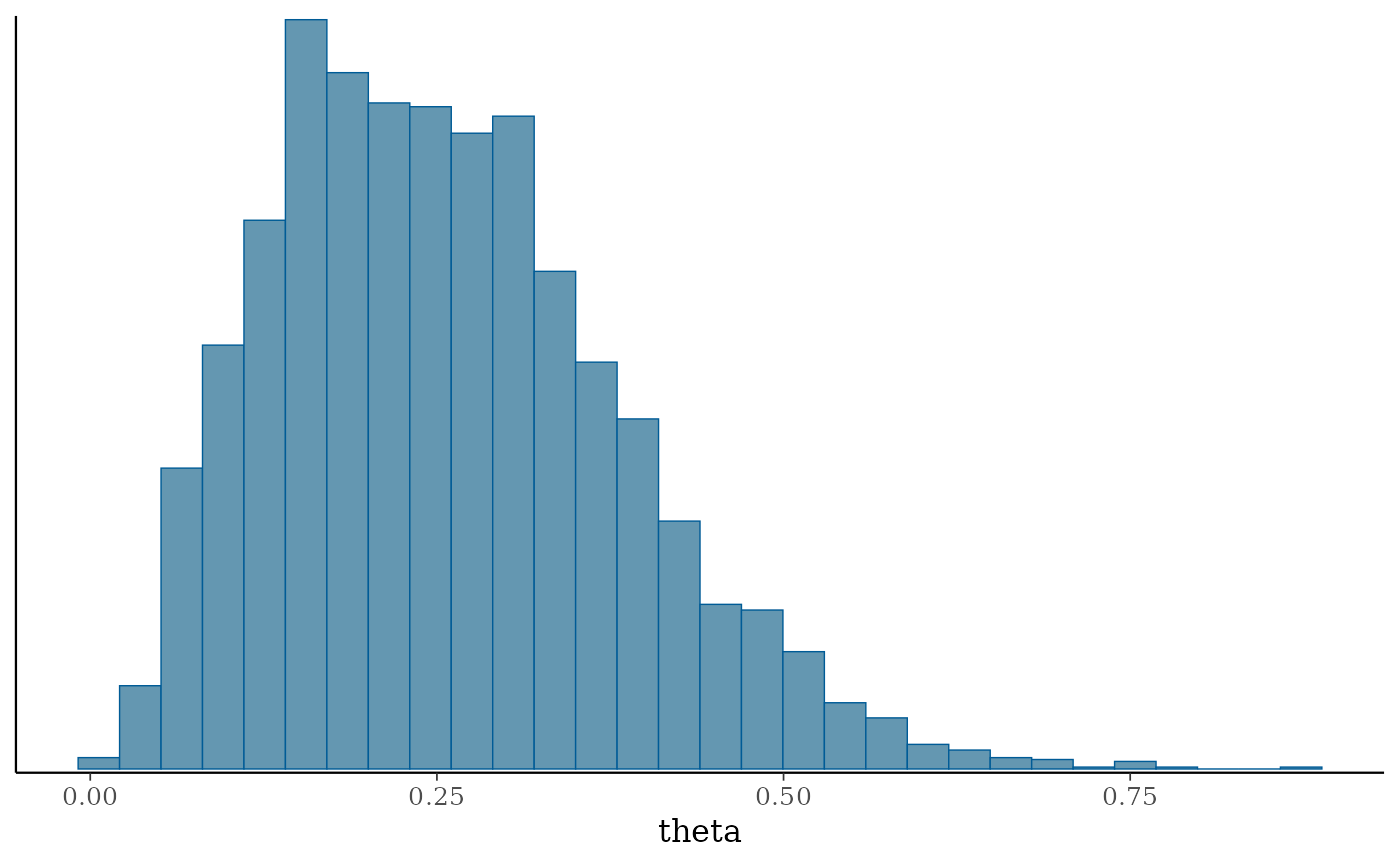
bayesplot::mcmc_hist(fit$draws("theta"))
#> `stat_bin()` using `bins = 30`. Pick better value `binwidth`.
 # }
# }